

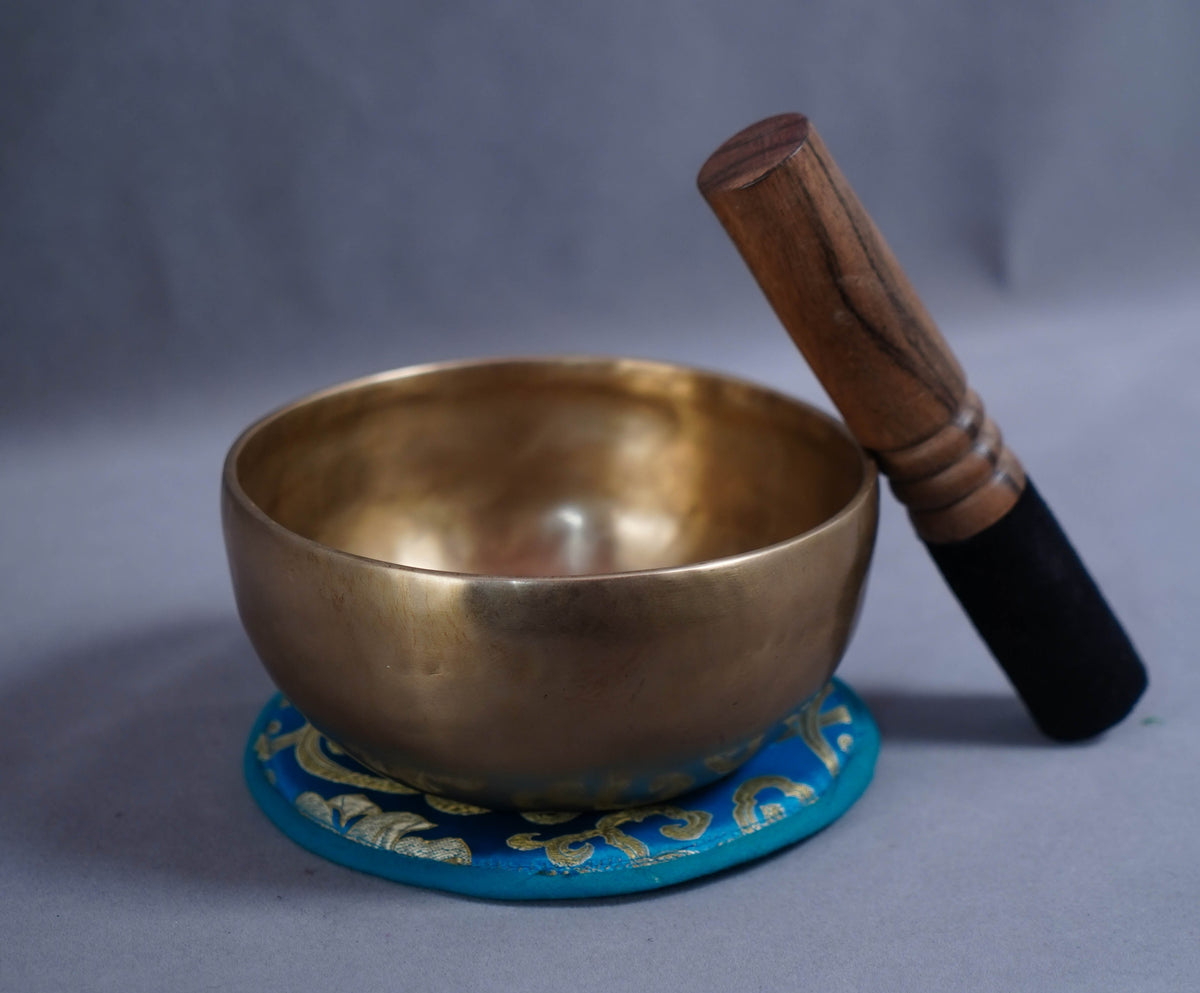
A Japanese rin is a bowl-shaped Buddhist bell. It sits on a small cushion on a household altar or in a temple, and it is struck with a short stick during prayers. A Himalayan singing bowl is a bowl from Nepal and the Himalayan region that you can strike with a mallet or circle around the rim until it sings. Both ring for a long time, but they come from different traditions, are made in different ways and sound different.

How do a Japanese rin and a Himalayan singing bowl compare?
| Japanese rin | Himalayan singing bowl | |
|---|---|---|
| Where it comes from | Japan. Most fine rin come from Takaoka in Toyama, a city that makes most of Japan's copperware | Nepal and the Himalayan region, mostly the Kathmandu Valley today |
| Traditional use | Rung on household Buddhist altars and in temples, during sutra recitation and prayers | Used today mainly for meditation and sound practice |
| Metal | Brass | Usually a bronze of copper and tin; many cast bowls are brass |
| How it is made | Fine rin: three brass parts (base, thin body, thick rim) joined, then hand-hammered and tuned by ear | Hammered by a team from a bronze disc, or cast in a mould and finished on a lathe |
| How it is played | Struck with a short stick, sitting on a cushion | Struck with a mallet, or circled around the rim so it sings |
| Sound | A clear, carrying ring, tuned by the maker | A main note with rich overtones, often with a slow warble |
What is a Japanese rin?
A rin, often called orin, is a bell shaped like a bowl. In a Japanese home it sits on the butsudan, the household Buddhist altar, on a small cushion called a rin futon, and it is struck with a stick called a rinbō. Rin are also known as keisu, and much larger ones are used in temples. A priest may sound the bell at the start of a sutra reading to give the chant its pitch, and strike it again at points in the ceremony.
A rin is a bell first: in Japan it belongs to the altar and to prayer.
How is a rin made?
Fine rin are made in Takaoka, in Toyama Prefecture, where Japan House London reports that about 95% of Japan's copperware is produced. A traditional maker joins three pieces of brass, a base, a very thin body and a thick rim, and hammers them into shape by hand, heating the metal in a kiln between rounds. The thick rim shapes the tone. The maker then tunes the bell by ear, tapping the upper part and listening until it sounds right. Only about ten artisans who make Buddhist bells this way are said to remain in Japan.
How is a Himalayan singing bowl made?
A hand-hammered Himalayan bowl starts as a disc of bronze. A team of smiths heats it until it glows and hammers it in turns, reheating it dozens of times as the walls and rim rise. A cast bowl is poured into a mould and smoothed on a lathe. Most bowls sold as "Tibetan" are made in Nepal, mainly in the Kathmandu Valley: singing bowls made in Nepal tells that story, and hand-hammered vs cast singing bowls compares the two methods.
How do they sound different?
A rin is tuned by its maker for a clear ring that carries, and Japanese makers describe its sound in stages: a first tone that fades within two or three seconds, a longer hum, and a deep tone underneath. A Himalayan bowl rings with a main note, its fundamental, and a stack of overtones above it. Many hand-hammered bowls also have a split note, two close tones that beat in a slow wah-wah called the warble. Our guide to how a singing bowl makes sound explains the overtones and the warble.
If you want to know a bowl's note, a tuner built for bowls helps with either, because both ring with overtones that confuse ordinary tuners. The free Mudra singing bowl tuner names the note, the hertz and the cents. We tested it on 73 Himalayan bowls, crystal bowls and a bell, but not on a Japanese rin.
Can I use a rin like a singing bowl?
You can strike a rin and listen to it ring down, which works well for a moment of quiet. Circling the rim with a mallet is a Himalayan-bowl technique: a rin is traditionally only struck. If you want a bowl you can rim, choose a Himalayan bowl, and see how to choose a singing bowl for the size and type that suit you.
Which should I choose?
- Choose a rin if you keep a Japanese Buddhist altar or follow a Japanese tradition. A rin belongs with the altar and its practice.
- Choose a Himalayan singing bowl if you want to strike and rim it, to pick a note, or to build a set in different sizes. Our guide to building a set of singing bowls helps with that.
We sell handmade Himalayan singing bowls from Kathmandu, not Japanese rin. Browse all our singing bowls, or read about the types of singing bowls first. Sound practice is for relaxation and meditation, not a medical treatment.
Questions people ask
Is a Japanese rin a singing bowl?
In English a rin is sometimes sold as a singing bowl, because of its shape and long ring. In Japan it is a Buddhist bell, used on altars and in temples during prayers.
What is a rin used for?
It is rung on a household Buddhist altar or in a temple, for example at the start of a sutra reading or a prayer.
Can you play a Japanese rin by circling the rim?
Traditionally a rin is only struck, with a short stick. Circling the rim belongs to Himalayan singing bowls.
What is a rin made of?
Brass. The finest are hammered by hand in Takaoka, Japan, from three brass parts and tuned by ear.
Are Himalayan singing bowls from Tibet or Nepal?
Most bowls sold as "Tibetan" are made in Nepal. "Tibetan" names the Himalayan Buddhist tradition, not the place of making. Read more in singing bowls made in Nepal.
Sources
- Japan House London: Orin, hand-hammered and carefully tuned Buddhist bells.
- Wikipedia: Butsudan.


