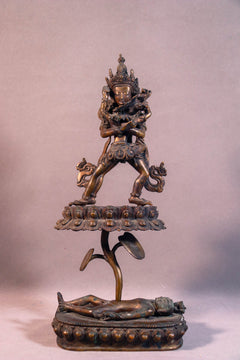
Hover to zoom. Click for full screen.
Vierarmige Mahakala-Statue: Der furchterregende Wächter der Weisheit
- Gottheit Mahakala
- Material Copper
- Herkunft Kathmandutal, Nepal
One of one. The statue in these photos is the statue you receive.
- Free shipping on orders over $150
- Wrapped by hand for the journey
- Secure checkout
Caring for your statue
Dust it with a soft, dry brush. Keep water and metal polish away from gilded, painted or darkened finishes: the gold and the patina are part of the statue. Lift it by its base, never by the arms or the crown.
Traditionally a statue sits at or above eye level, in a clean place, never on the floor.
Shipping and returns
Free shipping on orders over $150. Every statue is wrapped by hand for the journey.
Die Geschichte dieses Stücks
Vierarmige Mahakala-Statue: Der furchterregende Wächter der Weisheit
Ein furchterregender Wächter in der Kunst des Himalaya-Buddhismus
Sie verdienen es, jeden Tag in einem Zuhause voller vollkommener Ruhe zu leben. Diese Statue stellt Mahakala dar, traditionell einen furchterregenden Beschützer des Dharma.
Er steht fest in einem geformten Flammenkranz. Das Stück setzt einen eindrucksvollen Blickpunkt in Ihrem heiligen Raum.
Erleben Sie die Kraft des furchterregenden Mitgefühls
In der buddhistischen Tradition steht seine intensive spirituelle Energie für die Überwindung innerer Hindernisse. Seine zornvolle Erscheinung ist Ausdruck reinen, kraftvollen Mitgefühls.
Göttliche Form und heilige Symbolik
Seine furchterregende Gestalt wirkt erschreckend, birgt jedoch eine tiefe Bedeutung. Jedes Detail repräsentiert den vollkommenen Tod Ihres Egos.
Wesentliche zornige Merkmale
-
Die Kriegerhaltung: Er steht heute in einer kühnen, unbeweglichen Kriegerpose. Diese Haltung zeigt seine Bereitschaft, Hindernisse zu überwinden.
-
Die vier Arme: Vier dynamische Arme halten traditionelle Waffen spiritueller Weisheit. Das erhobene scharfe Schwert durchtrennt jegliche Verwirrung.
-
Der Feuerring: Ein lodernder Feuerring umgibt seinen gesamten Körper. Diese göttlichen Flammen verbrennen jegliches Zögern und alle Zweifel.
Außergewöhnliche Himalaya-Handwerkskunst und Detailtreue
Erfahrene Kunsthandwerker in Nepal gossen diese heilige Figur mit Hingabe. Sie verwendeten massives Kupfer für dauerhafte Stabilität und Gewicht.
Ein dunkles Antik-Finish verleiht ihr einen reichen, uralten visuellen Charakter. Jeder geschnitzte Flammenkontur bleibt bemerkenswert klar und scharf.
Dieses Stück fühlt sich schwer, solide und tief geerdet an. Es hat eine stetige, beruhigende Präsenz.
Spiritueller Zweck und ideale Platzierung im Zuhause
Platzieren Sie ihn überall dort, wo Sie eine Erinnerung an spirituelle Kraft wünschen. Sein stets wachsamer Ausdruck setzt ein kühnes Zeichen in Ihrem Zuhause.
Positionieren Sie diesen Wächter täglich in der Nähe Ihres Haupteingangs. Dort begrüßt er alle, die eintreten.
Seine Kriegerhaltung symbolisiert Mut und Selbstvertrauen. Lassen Sie seine unnachgiebige Gestalt Ihrem stillen, persönlichen Refugium Halt geben.
Produktspezifikationen
-
Material: Vollständig aus massivem Kupfer mit Antik-Finish gegossen.
-
Abmessungen: Vierzehn Zentimeter hoch und acht Zentimeter breit.
-
Herkunft: Von Meisterbildhauern in Patan, Nepal, handgegossen.
-
Technik: Unter Verwendung traditioneller Wachsausschmelzverfahren gegossen.
-
Stil: Authentische buddhistische Himalaya-Dharmapala-Kunst eines zornigen Beschützers.
Heiliger Segen und uraltes Mantra
Sprechen Sie sein uraltes Mantra täglich: OM MAHAKALA HUM PHAT.
Möge dieser göttliche Wächter Ihren heiligen Raum segnen. Möge sein Bildnis Sie inspirieren, widerstandsfähig, stark und furchtlos zu bleiben.
Mahakala
Lernen Sie Mahakala kennen
der Große Schwarze · Gonpo auf Tibetisch
Mahakala ist der große Beschützer der Lehren, eine zornvolle Gestalt des Mitgefühls selbst. Sein Gesicht ist furchterregend, damit das, was Schaden bringt, flieht. In vielen Klöstern bewacht sein Bild die Tür, und seine Maske wird bei den heiligen Cham-Tänzen getragen.
Worauf Sie achten können
Ein gebogenes Messer über einer Schädelschale, die er am Herzen hält.
Eine Krone aus fünf Schädeln und ein drittes Auge der Weisheit.
In seiner sechsarmigen Form steht er auf einer weißen elefantenköpfigen Gestalt, Vinayaka.
Om Mahakala Hum Phat
Genauer hinsehen
Every detail, finished by hand
The face, the hands, the jewels and the lotus beneath. Take your time with them.


How it was made
Wax, clay and fire
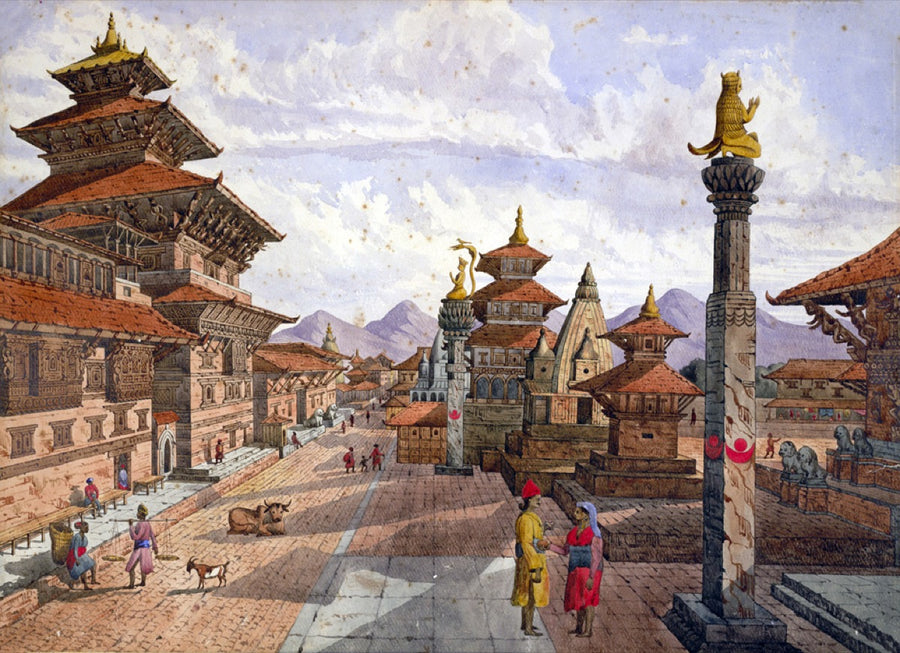
Metal statues like this one are cast by Newar artisans of the Kathmandu Valley the way their families have cast them for centuries: in lost wax, then finished by hand for days or weeks.
-
A figure in wax
The sculptor models the statue in beeswax softened with resin: warm enough to shape a face and fingers, firm enough to hold the smallest jewel.
-
Wrapped in clay
The wax is covered in coats of fine clay and left to dry, with small channels open for the metal to enter.
-
Fire
The mould is heated until the wax melts and runs out, leaving a hollow in its exact shape. Molten copper or bronze is poured in.
-
The mould is broken
Once the metal cools, the clay is broken away. A lost-wax mould can be used only once.
-
Chasing
With small chisels and punches the artist works over every surface: the eyes, the hair, the lotus petals, the patterns of the robe.
-
Gold, colour and the eyes
The statue is gilded, darkened or polished, and many faces are painted with gold and pigment. Painting the eyes comes last: it is when a statue is said to come alive.
Before you bring a statue home
The questions people ask us most. Anything else, write to us.
Ask us a questionIs the statue in the photos the one I'll receive?
For pieces sold one at a time, yes: each has its own listing, and the photos and size are of that statue. If a listing offers several pieces or sizes, they are made in small batches and vary a little from the photos.
Copper, bronze, gilded: what's the difference?
Copper takes fine chiselling and gold beautifully, so it is the classic metal of Newar statues. Bronze, copper with tin, is harder and darkens with age. A statue may then be gilded, darkened to an antique tone or left as bright copper. Each listing names its metal and finish.
Should the statue be consecrated?
That is your choice. Many families take a new statue to a monastery or temple, where it is filled with rolled prayers and blessed. If you would like to know whether a particular statue can be filled, write to us before you buy.
Do I need to be Buddhist to keep one?
No. Many people keep a statue as a work of art, a reminder or a focus for quiet moments. It is simply kind to treat it with respect: give it a clean place at or above eye level, not the floor or a bathroom, and don't use it as a bookend.
Can I see more of it before I buy?
Yes. Write to us and we'll gladly send more pictures of the piece.
Shipping and returns
Every statue is wrapped by hand for the journey, and shipping is free on orders over $150. See our refund policy for returns.