Dunkle Kupferstatue von Vajrapani (18 cm)
Price
$210.52
Kostenloser Versand ab einem Bestellwert von $150
Handgefertigt in Nepal, weltweit versandt
Neu: Mudra, unsere kostenlose App zum Stimmen von Klangschalen


Hover to zoom. Click for full screen.
One of one. The statue in these photos is the statue you receive.
Dust it with a soft, dry brush. Keep water and metal polish away from gilded, painted or darkened finishes: the gold and the patina are part of the statue. Lift it by its base, never by the arms or the crown.
Traditionally a statue sits at or above eye level, in a clean place, never on the floor.
Free shipping on orders over $150. Every statue is wrapped by hand for the journey.
Die Geschichte dieses Stücks
Bringen Sie noch heute intensive schützende Energie an Ihren heiligen Hausaltar. Vajrapani durchbricht spirituelle Hindernisse und beseitigt negative Energie schnell.
Meisterhafte Himalaya-Bildhauer haben dieses Stück aus massivem Kupfer handgegossen. Filigrane Flammen-Details fangen den wilden Geist erwachter Kraft ein.
Er steht in einer breiten, kraftvollen Kriegerpose voller Stärke. Diese dynamische Haltung symbolisiert den vollständigen Sieg über Täuschung und Angst.
Drei grimmige Köpfe zeigen dritte Augen und scharfe Reißzähne. Kunstvolle Totenkronen repräsentieren die Umwandlung toxischer Emotionen in reine Weisheit.
Sein stilisiertes Haar flammt wie ein wildes Feuer nach oben. Dieser strahlende Heiligenschein repräsentiert intensive spirituelle Energie, die Illusionen verbrennt.
Himalaya-Metallkünstler bearbeiten jedes Detail mit traditioneller, jahrhundertealter Sorgfalt. Der robuste Sockel hält diese Skulptur überall perfekt im Gleichgewicht.
Platzieren Sie ihn an Ihrem Eingang, um sich gegen chaotische Energien zu schützen.
Konzentrieren Sie sich während der Meditation auf seine Form, um furchtloses Selbstvertrauen aufzubauen.
Höhe: Misst 26 cm hoch, einschließlich des Holzsockels.
Breite: Misst 26 cm breit über seine Kriegerhaltung.
Material: Handgegossene massive Kupferlegierung, montiert auf einem Holzsockel.
Herkunft: Handgefertigt von traditionellen Meistermetallurgen in Patan, Nepal.
Vajrapani
Vajra in der Hand · Chana Dorje auf Tibetisch
Vajrapani ist die Kraft der Buddhas, ein Beschützer, der die Lehren bewahrt. Mit Manjushri (Weisheit) und Chenrezig (Mitgefühl) bildet er die Herren der drei Familien, oft Seite an Seite in Himalaya-Häusern zu sehen. Sein grimmiger Blick gilt nur dem, was Ihnen schadet, nicht Ihnen.
Ein Vajra, in der rechten Hand hoch erhoben, schlagbereit.
Ein breiter Stand in einem Flammenkranz.
Ein Tigerfell um die Hüfte und Schlangen als Schmuck.
Om Vajrapani Hum
Genauer hinsehen
The face, the hands, the jewels and the lotus beneath. Take your time with them.


How it was made
Metal statues like this one are cast by Newar artisans of the Kathmandu Valley the way their families have cast them for centuries: in lost wax, then finished by hand for days or weeks.
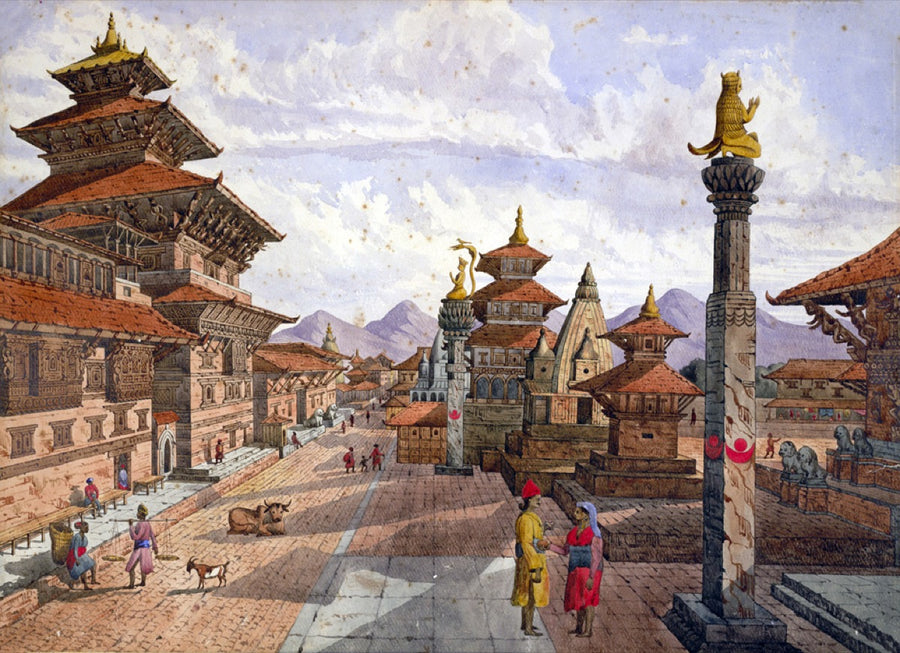
The sculptor models the statue in beeswax softened with resin: warm enough to shape a face and fingers, firm enough to hold the smallest jewel.
The wax is covered in coats of fine clay and left to dry, with small channels open for the metal to enter.
The mould is heated until the wax melts and runs out, leaving a hollow in its exact shape. Molten copper or bronze is poured in.
Once the metal cools, the clay is broken away. A lost-wax mould can be used only once.
With small chisels and punches the artist works over every surface: the eyes, the hair, the lotus petals, the patterns of the robe.
The statue is gilded, darkened or polished, and many faces are painted with gold and pigment. Painting the eyes comes last: it is when a statue is said to come alive.
The questions people ask us most. Anything else, write to us.
Ask us a questionFor pieces sold one at a time, yes: each has its own listing, and the photos and size are of that statue. If a listing offers several pieces or sizes, they are made in small batches and vary a little from the photos.
Copper takes fine chiselling and gold beautifully, so it is the classic metal of Newar statues. Bronze, copper with tin, is harder and darkens with age. A statue may then be gilded, darkened to an antique tone or left as bright copper. Each listing names its metal and finish.
That is your choice. Many families take a new statue to a monastery or temple, where it is filled with rolled prayers and blessed. If you would like to know whether a particular statue can be filled, write to us before you buy.
No. Many people keep a statue as a work of art, a reminder or a focus for quiet moments. It is simply kind to treat it with respect: give it a clean place at or above eye level, not the floor or a bathroom, and don't use it as a bookend.
Yes. Write to us and we'll gladly send more pictures of the piece.
Every statue is wrapped by hand for the journey, and shipping is free on orders over $150. See our refund policy for returns.
Your order ships free