


"Hand-hammered" is on a lot of singing bowl listings, and it does not always mean the same thing. Below are six hand-hammered bowls we would recommend for six different jobs, from a first bowl that fits in one hand to a 34 cm bowl for a sound bath. All six were shaped by hammer in Kathmandu, Nepal, and all are in stock at Mudra Craft as we write this.
Each one is a single bowl, not a design made in batches. The photos on its listing show the exact bowl you receive, with its size and note, and its weight where we have it.
What "hand-hammered" means
A hand-hammered bowl starts as a disc of hot bronze. Metalworkers heat it and beat it out over and over until it becomes a bowl, and the hammer leaves small facets on the surface that you can still see and feel. Nepal's Kathmandu Valley has a long tradition of this kind of metalwork. Lalitpur, also called Patan, is known for its metalworkers (Encyclopaedia Britannica, Lalitpur), and the Rubin Museum notes that Newar artists of the valley perfected techniques in which metal sheets are hammered over shaped forms (Rubin Museum).
The other common way to make a bowl is to cast it in a mould and then turn it on a lathe, which gives smooth, even walls and fine machined rings. Cast bowls can sound lovely and cost less. We sell both, and we label every bowl so you know which one you are buying. Our guide to hand-hammered vs cast singing bowls goes deeper into the differences.
Singing bowls are generally made of a bronze alloy (Terwagne and Bush, 2011). Bronze is mainly copper and tin, and bell metal is a bronze with a high tin content, prized for how it rings when struck (Encyclopaedia Britannica, bronze). Some of ours are described as 7 metal bronze, and where that is the case we say so on the listing.
Quick picks
| Best for | Bowl | Size | Note |
|---|---|---|---|
| A first bowl | Tiger Jambati | 12 cm, 0.47 kg | D |
| No imagery | Dim Plain Jambati | 15 cm | D |
| A footed bowl | Naga Plain Antique | 17 cm | C |
| Layered overtones | Lingam Tiger Full Moon | 22 cm | G |
| Etching on every surface | Jambati Sri Yantra | 23 cm | D |
| Sound baths and groups | Shakyamuni Buddha Silver Carved Jambati | 34 cm | A |
Best first bowl: 12 cm Tiger Jambati, note D
If you are buying your first singing bowl, start small. This Tiger Jambati is 12 cm across and weighs 0.47 kg, so you can hold it upright in one hand while you play.
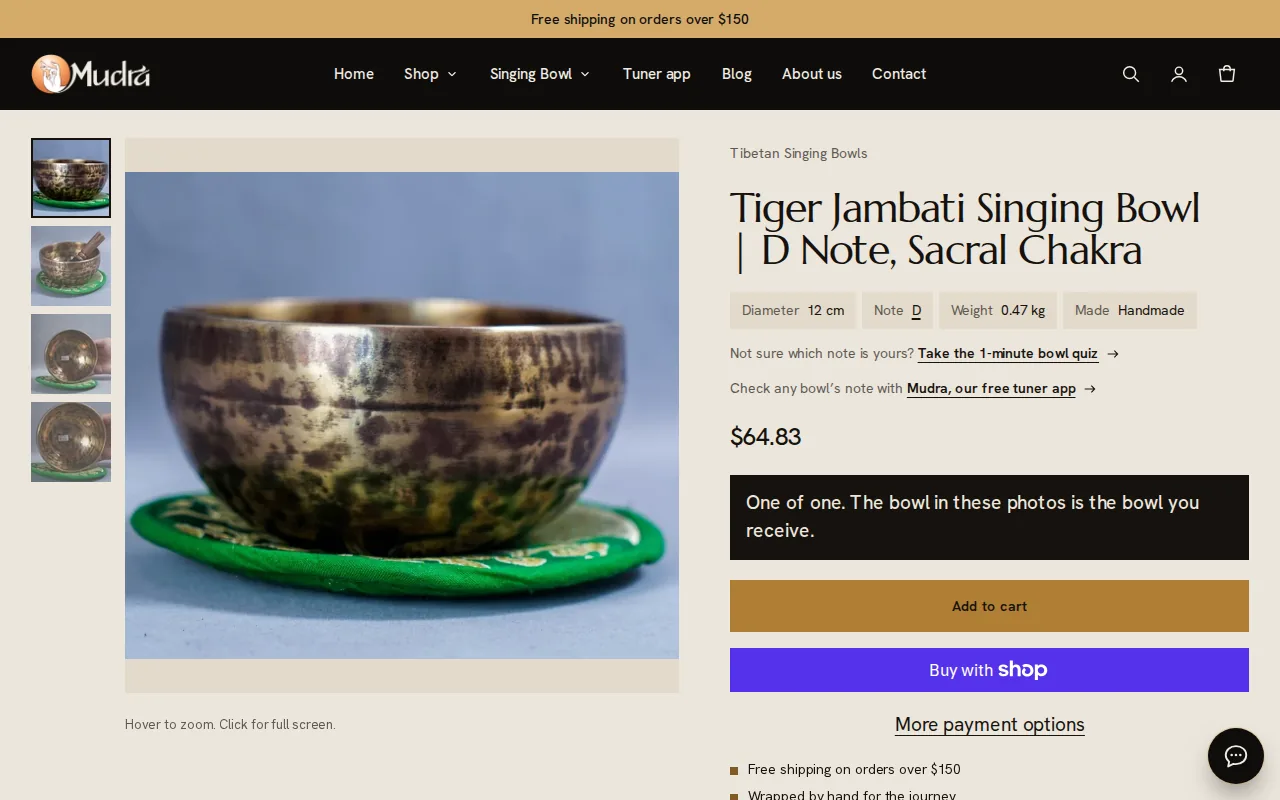
Why we like it: the dark tiger-stripe patina comes from the making itself. Oxidation spots and hammer marks gather into bands across the bronze and run down the inside walls, so you can see exactly how it was made. It is light enough to take to a class or keep beside your meditation cushion.
Keep in mind: a small bowl has a brighter, shorter voice than a large one. That suits short daily sessions better than a long sound bath.
Best plain bowl: 15 cm Dim Plain Jambati, note D
Many hand-hammered bowls are etched with deities, mantras or symbols. If you would rather have none, this is the one. The Dim Plain Jambati has smooth walls with no etching, symbol or pattern, and a warm, subdued finish.
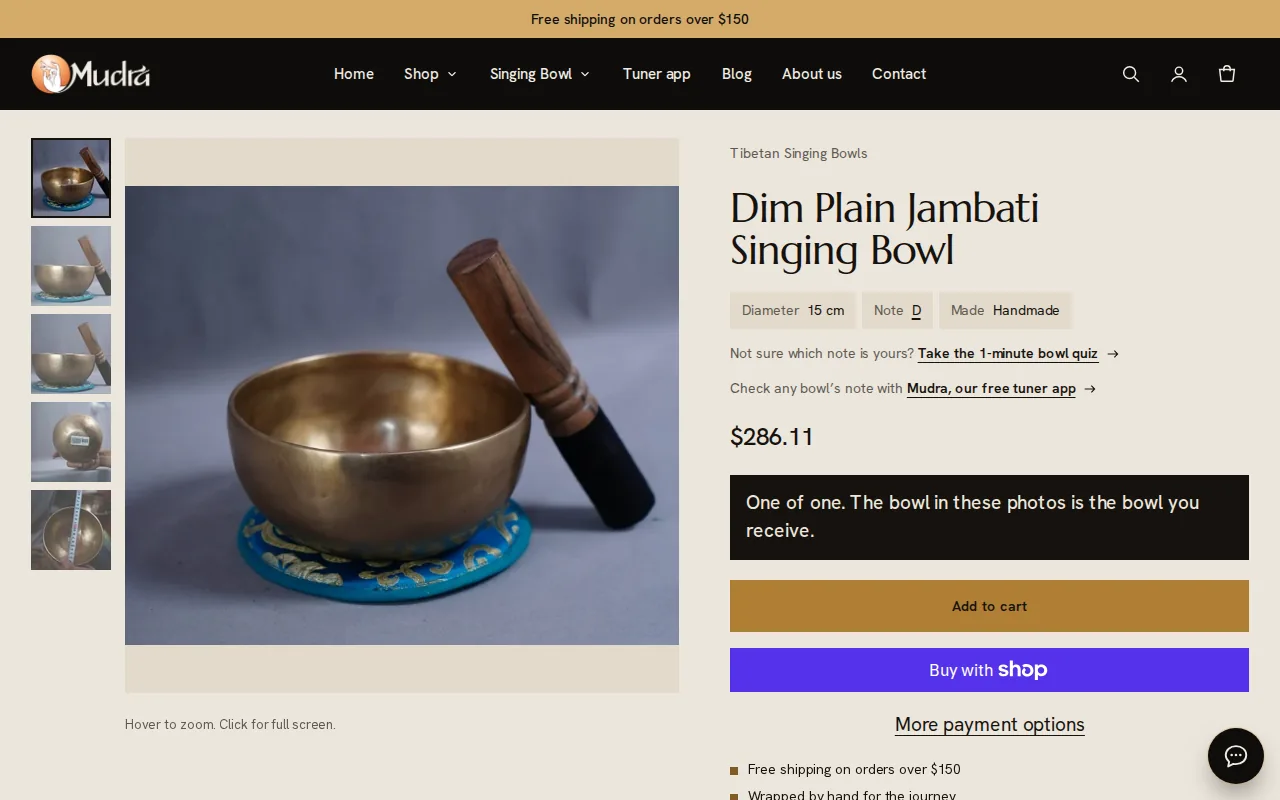
Why we like it: with nothing to look at, your attention goes to the sound. Struck with the suede-tipped mallet it gives a warm tone that lingers, and circled slowly at the rim it settles into a steady hum. It is also a good choice for a yoga studio, a therapy room or a gift for someone who prefers no religious imagery.
Best footed bowl: 17 cm Naga Plain Antique, note C
Most singing bowls sit flat on their base. A Naga bowl stands on a raised pedestal foot, which gives this one an upright, almost chalice-like profile on its cushion.
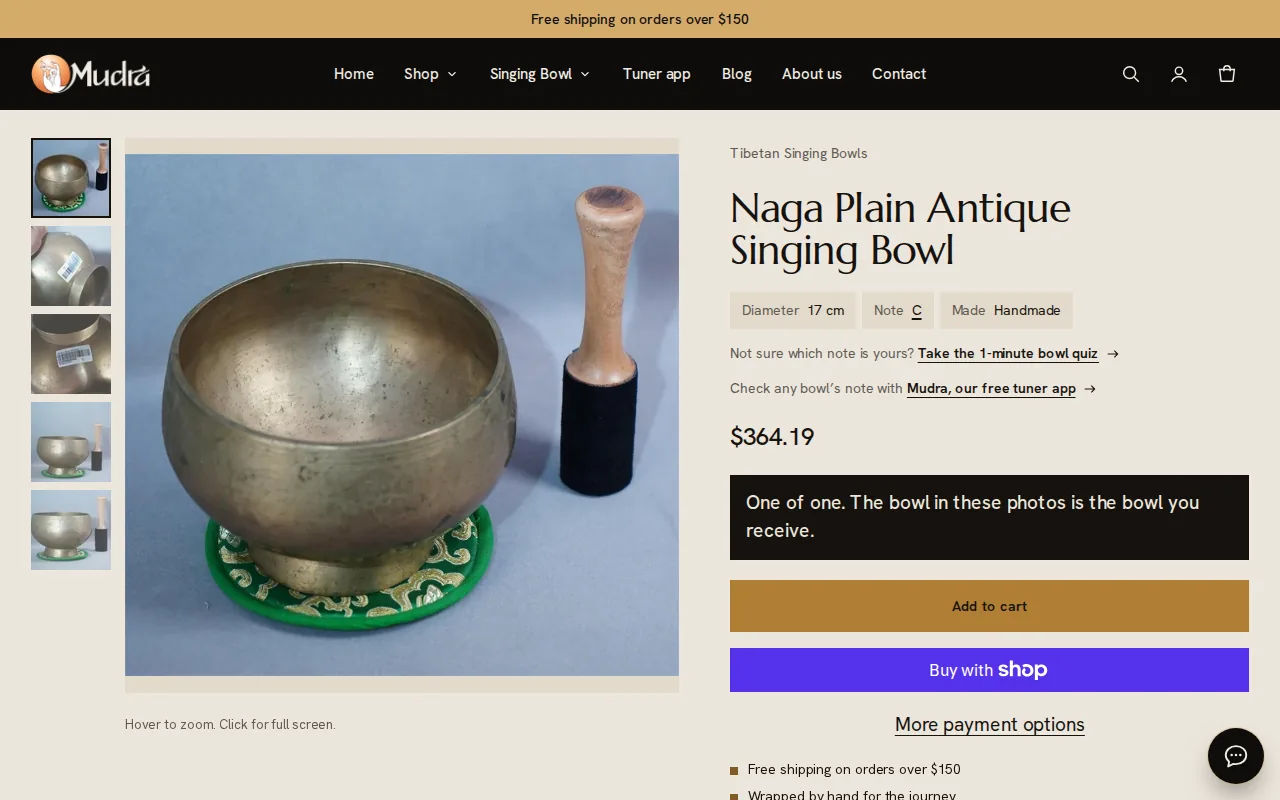
Why we like it: it is an unusual shape that still plays simply. Give the rim one firm strike with the wooden mallet and let the C fade before the next. C opens the traditional chakra scale and is paired with the root, so many people use a bowl like this to begin a sitting.
Keep in mind: "Antique" is part of the bowl's name and describes its aged-style patina. We make no claim about its age.
Best for layered overtones: 22 cm Lingam Tiger Full Moon, note G
A raised point rises from the floor of this bowl. Rings of hammer marks circle inward and climb to it, and that point, the lingam, gives the bowl its name. The outside wears a mottled tiger patina with the round Full Moon symbol carved on the wall.
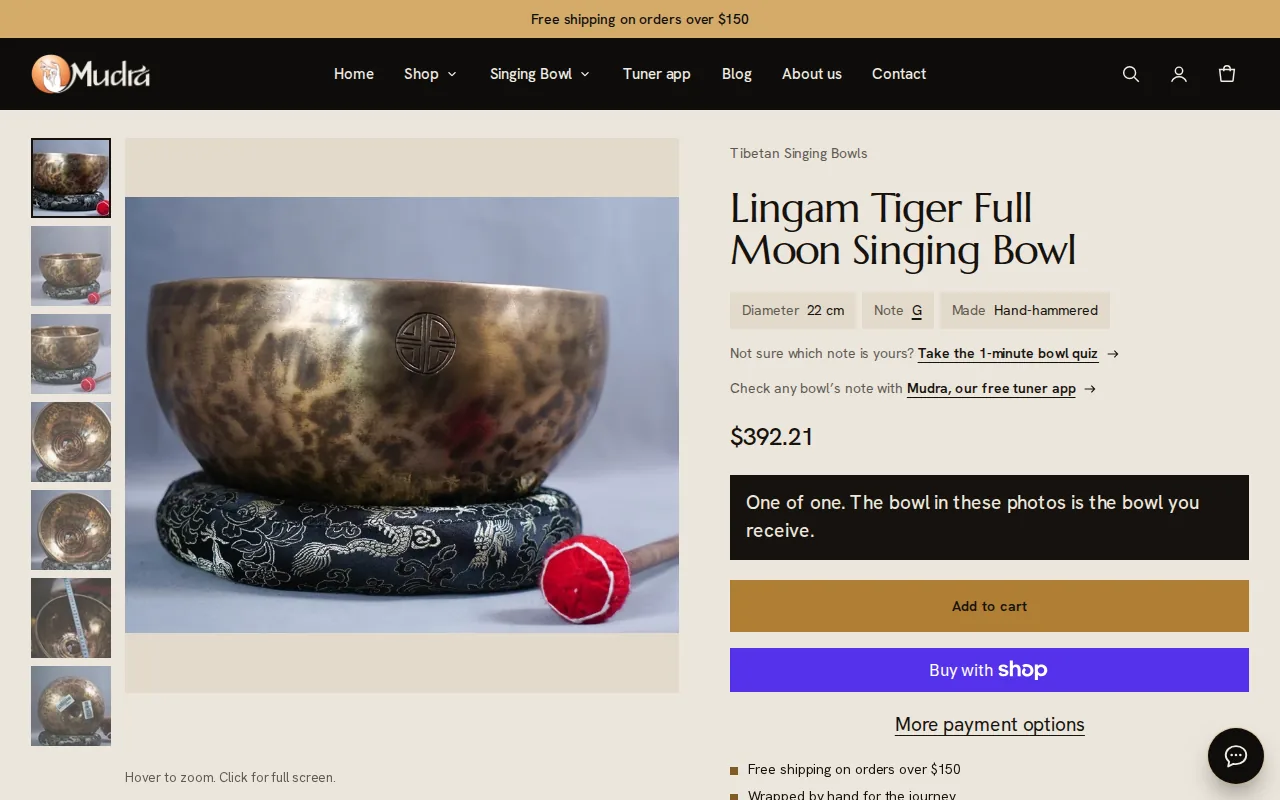
Why we like it: strike the outer rim and you hear a clear G with layers of overtone above it, and the raised centre adds to that layering. It is three styles in one bowl: a Lingam, a Tiger and a Full Moon. Underneath, a dimple marks the centre of the base, right below the raised point.
Best etched bowl: 23 cm Jambati Sri Yantra, note D
This is the most detailed bowl on the list. It is hand-hammered from 7 metal bronze and etched on all three surfaces: rows of mantra script around the outside, a lotus opening around an Om inside, and the Sri Yantra, a figure of nine interlocking triangles from Hindu tradition, on the base.
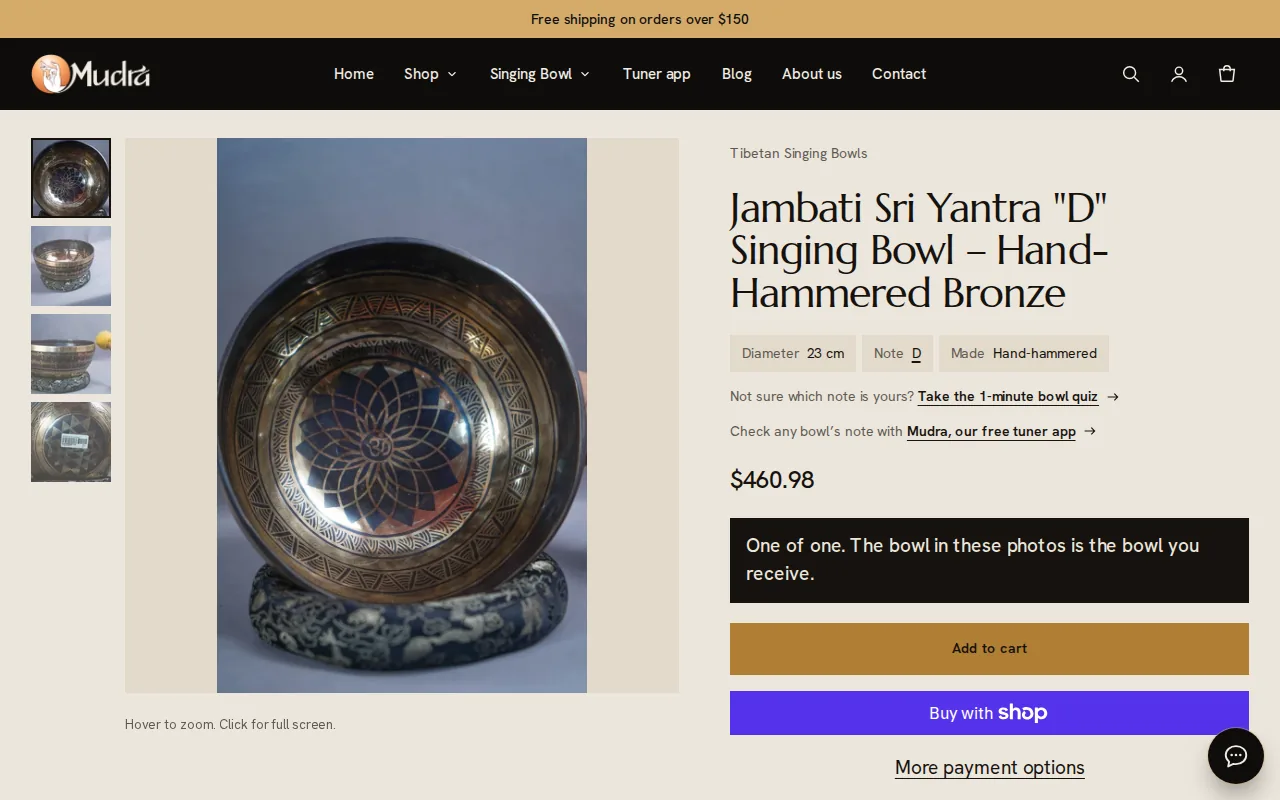
Why we like it: Jambati bowls are the heavy-walled, open kind, and this one gives a low, layered tone that hangs in the air long after each strike. It works as an instrument for sound therapy and as a piece to keep on an altar.
Best large bowl for sound baths: 34 cm Shakyamuni Buddha Silver Carved Jambati, note A
For a room full of people you want a big bowl. At 34 cm this Jambati is too large to balance on a palm, so it is played resting on its cushion. A seated Shakyamuni Buddha, worked in silver with red detail, sits at the very bottom of the basin.
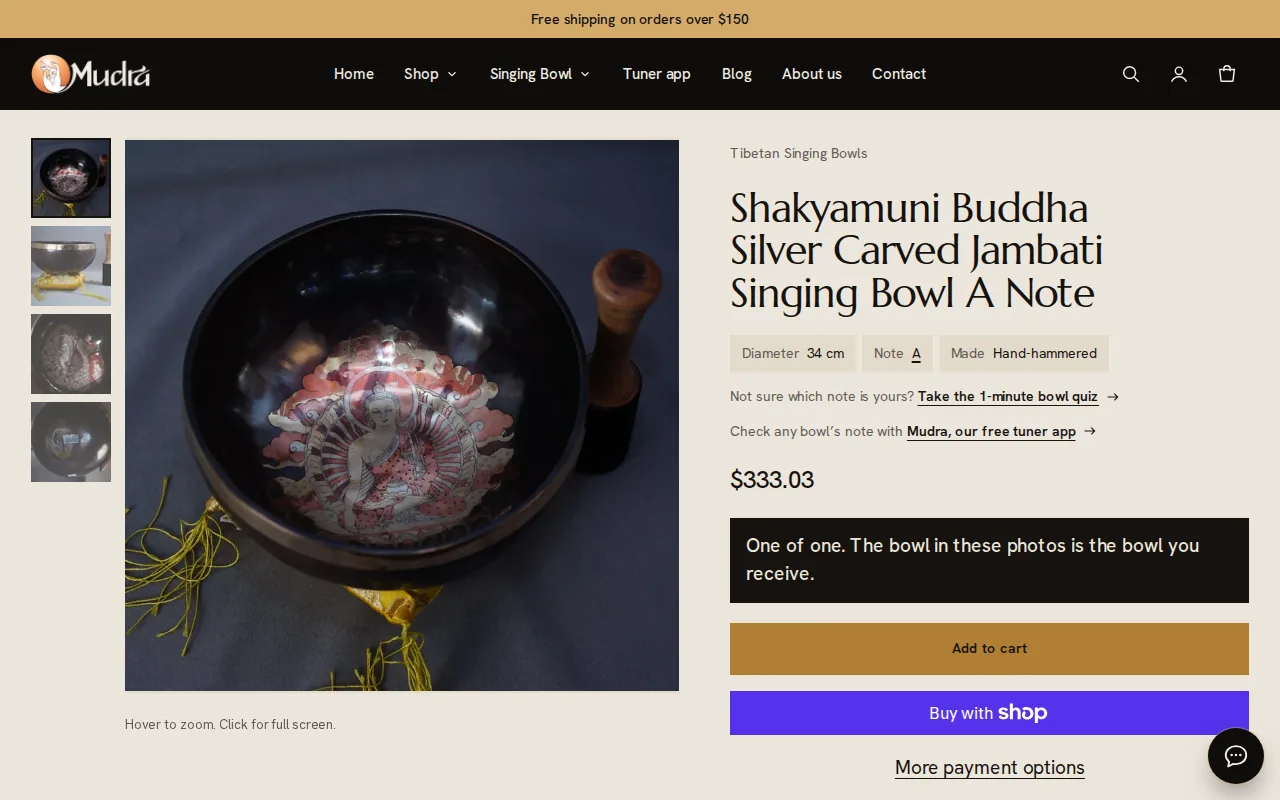
Why we like it: struck with the mallet it gives a bright, clear A, and the hammered walls carry it in a long, even sustain. Between sessions it sits well on an altar or a low shelf.
Want a large bowl with a warmer, more layered voice instead? The Full Moon Tiger in note F weighs 1.17 kg and builds into a continuous wall of sound when you circle its rim.
How to choose between them
Start with where and how you will play. A bowl you hold in your palm needs to be light enough to keep steady for a few minutes, which points to the 12 cm Tiger Jambati or the 15 cm Dim Plain. A bowl that will stay on a cushion, in a studio or at the front of a group, can be as large as you like, and a bigger bowl usually gives a deeper, longer sound.
Next, think about what you want to see. Some people want a bowl that is also a devotional object, with a Buddha, a deity or a yantra etched into it. Others want bare bronze. Both are equally hand-hammered; the etching is added after the bowl is shaped.
Last, decide on the note. If you follow the chakra tradition, the note decides which chakra a bowl is paired with on our chart, from C for the root to B for the crown. If you are building a set, our guide to building a singing bowl set helps you choose which note to buy first.
How to check a bowl is really hand-hammered
You do not need to take a listing's word for it. These checks work in a shop and when your bowl arrives:
- Look for facets. Tilt the bowl under a light. Hammered bronze shows many small, uneven dents, often clearest on the inside walls. A cast and lathe-turned bowl shows smooth walls and evenly spaced machined rings.
- Check the base. Turn the bowl over. Hammer marks often continue across the underside of a hammered bowl, while a lathe-turned base shows neat concentric rings.
- Compare size and weight. Ask for both. A seller who has handled the bowl can tell you.
- Listen to it. Strike it and circle the rim. Our guide on how to test a singing bowl covers what to listen for, and Mudra, our free tuner app, shows the note and hertz on your phone.
Physicists who have studied singing bowls describe the sound as several vibration modes of the bowl's wall ringing together, which is why the shape and thickness that hammering leaves behind change the voice (Terwagne and Bush, MIT, published in Nonlinearity). Our guide to how singing bowls make sound explains this in plain terms.
Frequently asked questions
Are hand-hammered singing bowls better than cast bowls?
Not always. They are made differently and often sound different, with more visible character in the metal. Cast bowls are more uniform and cost less. Choose the sound and the bowl you like.
Where are hand-hammered singing bowls made?
Many come from Nepal, especially the Kathmandu Valley. Every bowl in this list was made by artisans in Kathmandu.
What size hand-hammered bowl should I buy first?
A bowl of about 12 to 17 cm is easy to hold and play. Choose a larger bowl, 22 cm and up, if you mainly plan to play it on a cushion or for a group.
Why do two hand-hammered bowls in the same note sound different?
Each one is shaped by hand, so wall thickness, weight and shape vary. Those differences change the overtones and how long the sound lasts.
Does a hand-hammered bowl need special care?
Keep it dry, wipe it with a soft cloth and store it on its cushion. Our guide on how to clean a singing bowl covers patinas and etched surfaces.
Ready to find yours? See all our hand-hammered and 7 metal bowls at Mudra Craft. Each bowl is one of one, and the bowl in the photos is the bowl you receive.


