

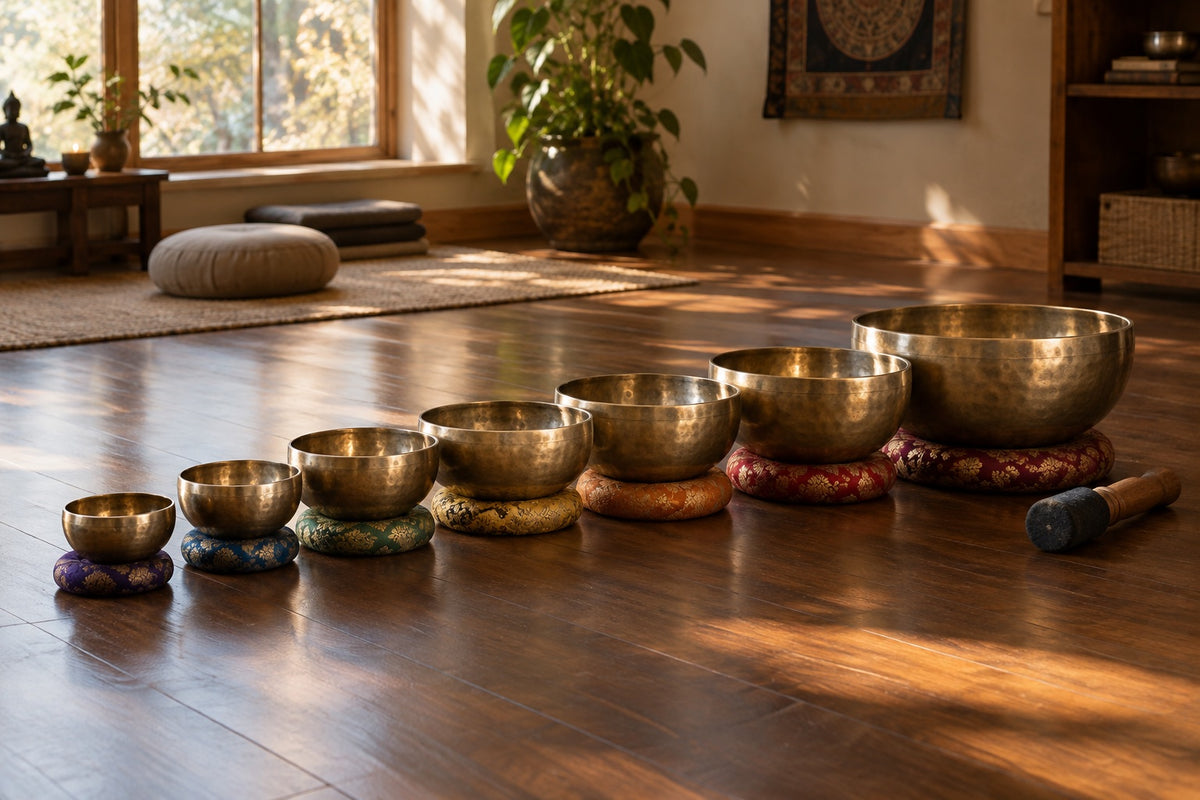
If you already know the note you want, choosing a singing bowl gets much easier. You stop scrolling through hundreds of bowls that "sound beautiful" and start comparing the few that actually sound your note. This list does that for you: one hand-hammered bowl for each note from C to A, all made by artisans in Kathmandu, Nepal, and all in stock at Mudra Craft as we write this.
Every bowl below is one of a kind. The photos on each listing show the exact bowl you receive, and the note on each listing is one we checked. If a pick has sold by the time you read this, the note collection linked under it shows what else we have in that note.
How we picked one bowl per note
We started with every singing bowl in our shop that has a checked note on its listing. Then we kept only hand-hammered bowls, so every pick is shaped by hand rather than cast in a mould and turned on a lathe. (Our guide to hand-hammered vs cast singing bowls explains how to tell them apart.)
For each note we then chose the bowl that does the best all-round job: easy to play, a clear fundamental, and a size that suits the way most people use that note. Where a note has more than one strong bowl, we name the runner-up too.
A word on what "note" means here. A singing bowl sounds a fundamental tone plus a set of higher partials, and the note on a listing names the fundamental. Physicists who have studied these bowls describe the sound as several vibration modes ringing at once, which is why two bowls in the same note can still sound quite different (Terwagne and Bush, "Tibetan singing bowls", Nonlinearity, 2011).
The seven notes at a glance
The chakra pairings below are a tradition, not a measurement. They follow the one chart we use across our shop and our note-to-chakra guide. The hertz values are the standard equal-tempered pitches for the octave around middle C, with A set to 440 Hz as the international standard pitch (ISO 16) and each semitone an equal step above the last (Georgia State University HyperPhysics). A real bowl can sound its note in a lower or higher octave and a few hertz sharp or flat.
The same tradition also gives each chakra a colour, with orange for the sacral, the chakra our chart pairs with note D. If that side of the practice interests you, Auras of Osiris has a short guide to what an orange aura is said to mean.
| Note | Hz (octave 4) | Traditional chakra | Our pick | Size |
|---|---|---|---|---|
| C | 261.63 | Root | Black Full Moon Jambati | 15 cm |
| D | 293.66 | Sacral | Hand Etched Om Jambati | 24 cm |
| E | 329.63 | Solar plexus | Vairocana Jambati | 21 cm |
| F | 349.23 | Heart | Full Moon Tiger | about 18 to 20 cm |
| G | 392.00 | Throat | Black Jambhala Etched Jambati | 17 cm |
| A | 440.00 | Third eye | Jambati Tiger Full Moon | 25 cm |
| B | 493.88 | Crown | None in stock right now |
Best note C singing bowl: 15 cm Black Full Moon Jambati
C opens the scale, so it is the note many people start with. Our pick is a small Full Moon Jambati, hand-hammered from 7 metal bronze, with a black herbal finish, a polished gold rim and a mantra engraved around the outside.
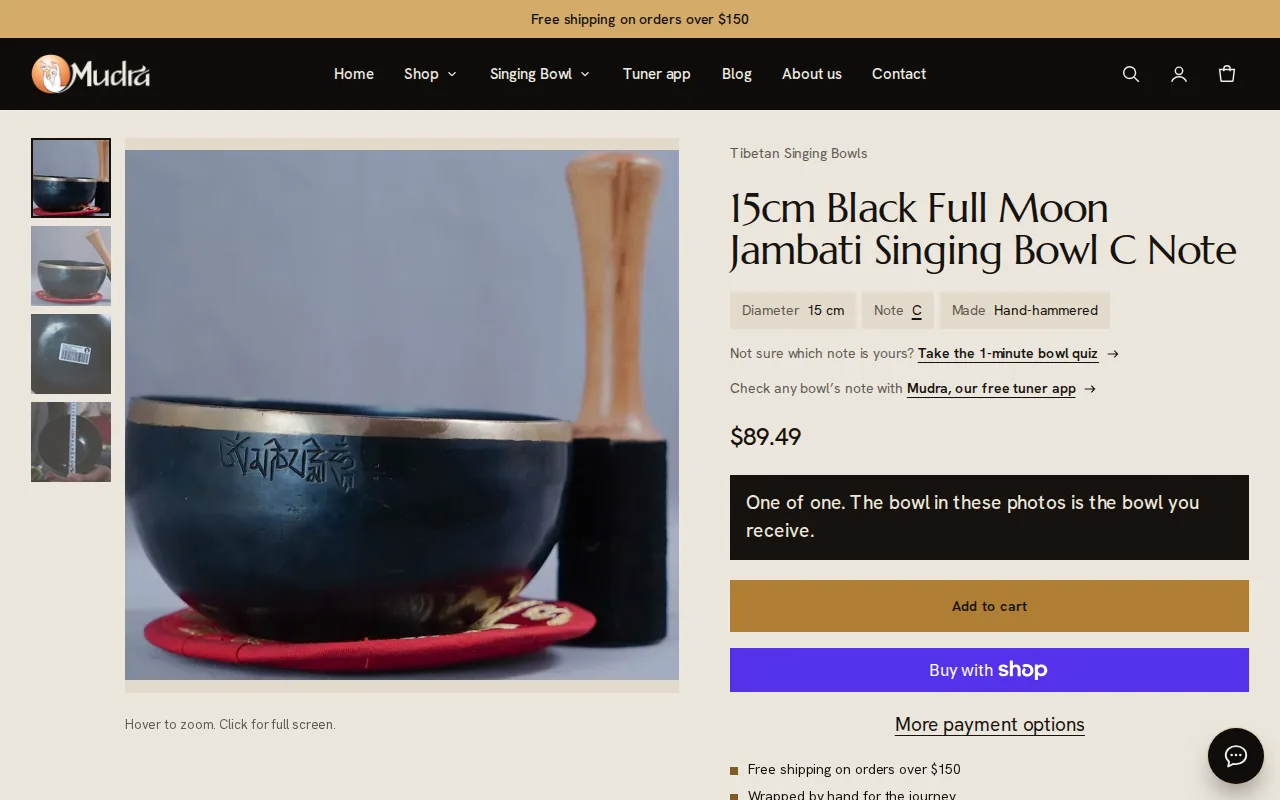
Why it wins: at 15 cm it sits on an open palm, so you can hold it while you play, then rest it on its cushion. That makes it a usable first C for daily meditation, and an easy bowl to carry to a class.
Good to know: a small bowl gives a brighter, quicker voice than a large one. If you want a slower, deeper C to anchor a set, look at the footed 17 cm Naga Plain Antique in note C instead. See every C bowl in our note C collection.
Best note D singing bowl: 24 cm Hand Etched Om Jambati
D is where we have the most choice, which made this the hardest call. We went with the 24 cm Hand Etched Om Jambati: a broad, open bowl with gold Om symbols on a black band outside and a Flower of Life pattern etched inside.
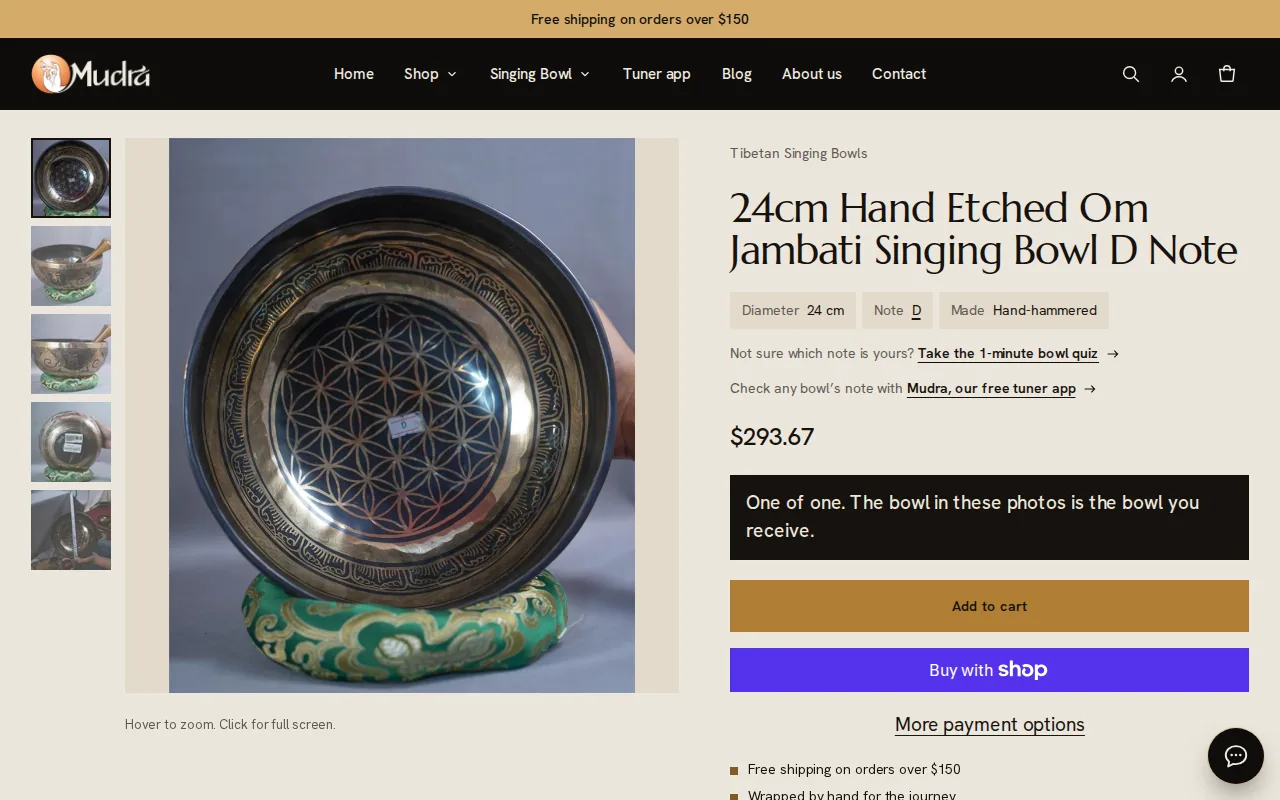
Why it wins: at 24 cm its hammered walls hold the D long after each strike, and when you circle the rim slowly the hum builds and then holds. That suits sound baths and long sittings, which is where most people use a D.
Runners-up: for a bowl with no imagery at all, the 15 cm Dim Plain Jambati. For a light D to travel with, the 12 cm Tiger Jambati, which weighs 0.47 kg. All of them are in the note D collection.
Best note E singing bowl: 21 cm Vairocana Jambati
E bowls are less common than C or D. Ours is a 21 cm Jambati weighing 1.31 kg, etched in silver and copper with the Buddha Vairocana, known in Japan as Dainichi Nyorai, seated at its centre.
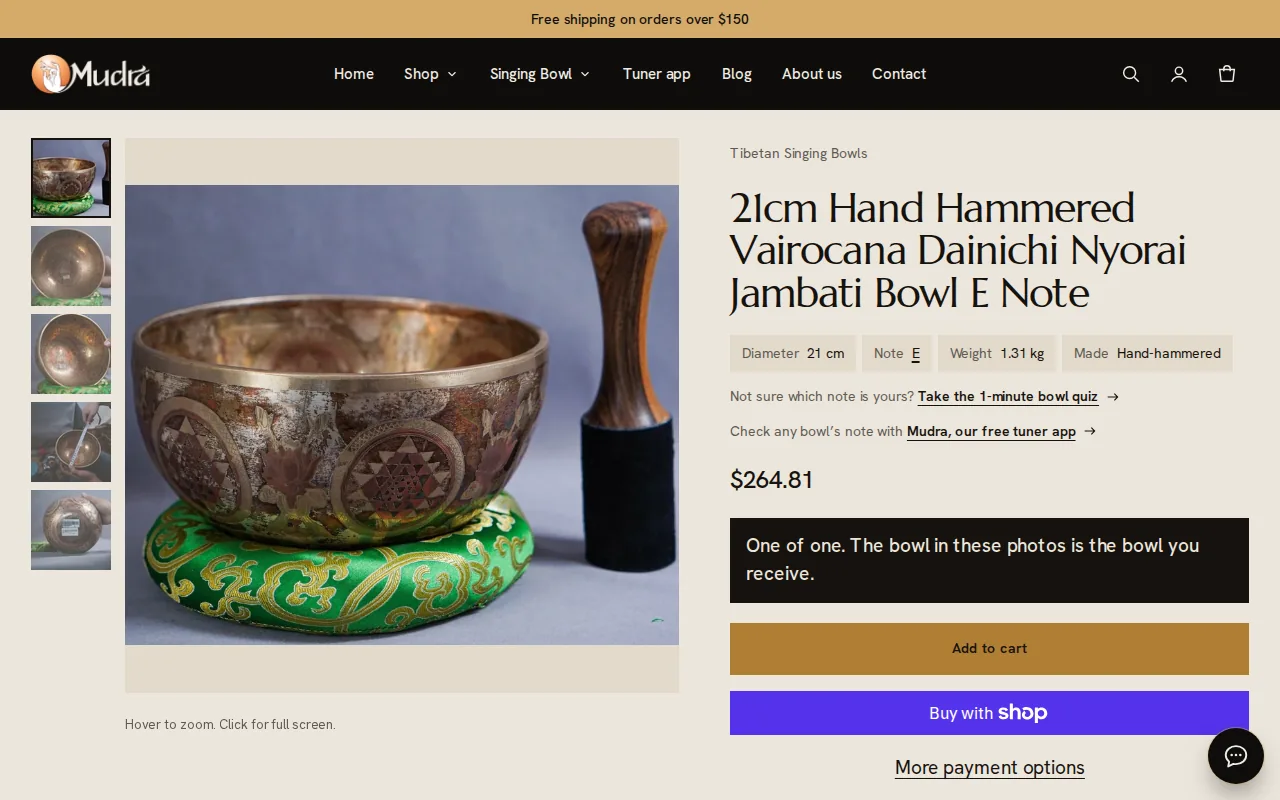
Why it wins: 21 cm is a comfortable middle size. It rests on an open palm for short sessions and settles on its ring cushion for longer ones, and the hammered bronze gives a warm tone with layered overtones. The etching also makes it a bowl to keep on an altar between sessions.
Best note F singing bowl: Full Moon Tiger
Our F is a Full Moon Tiger bowl, hand-hammered from 7 metal bronze, about 18 to 20 cm across and 1.17 kg. Dark bands of oxidation cross its golden body like tiger stripes, and a round carved symbol sits on its side.
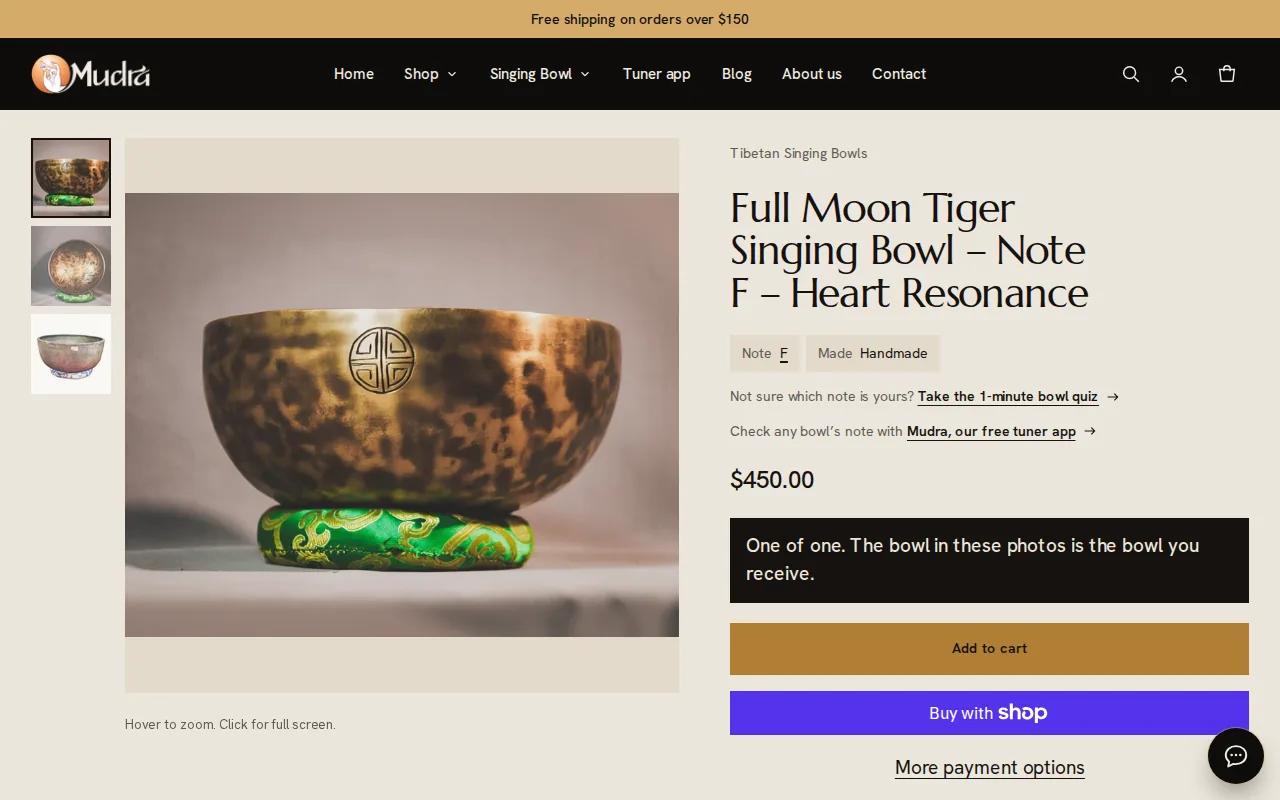
Why it wins: this is the most layered voice on the list. Struck with a soft mallet, the F comes in warm and full with many overtones above it, and as it fades a slow beat rises and falls in the sound. Circle the rim with a suede striker and it builds into a continuous wall of sound, enough to carry a sound bath on its own.
Best note G singing bowl: 17 cm Black Jambhala Etched Jambati
The G pick is small but etched all over: Black Jambhala seated inside, six Om roundels circled by mantra script outside, and a pair of Buddha eyes on the base. It is hand-hammered from 7 metal bronze.
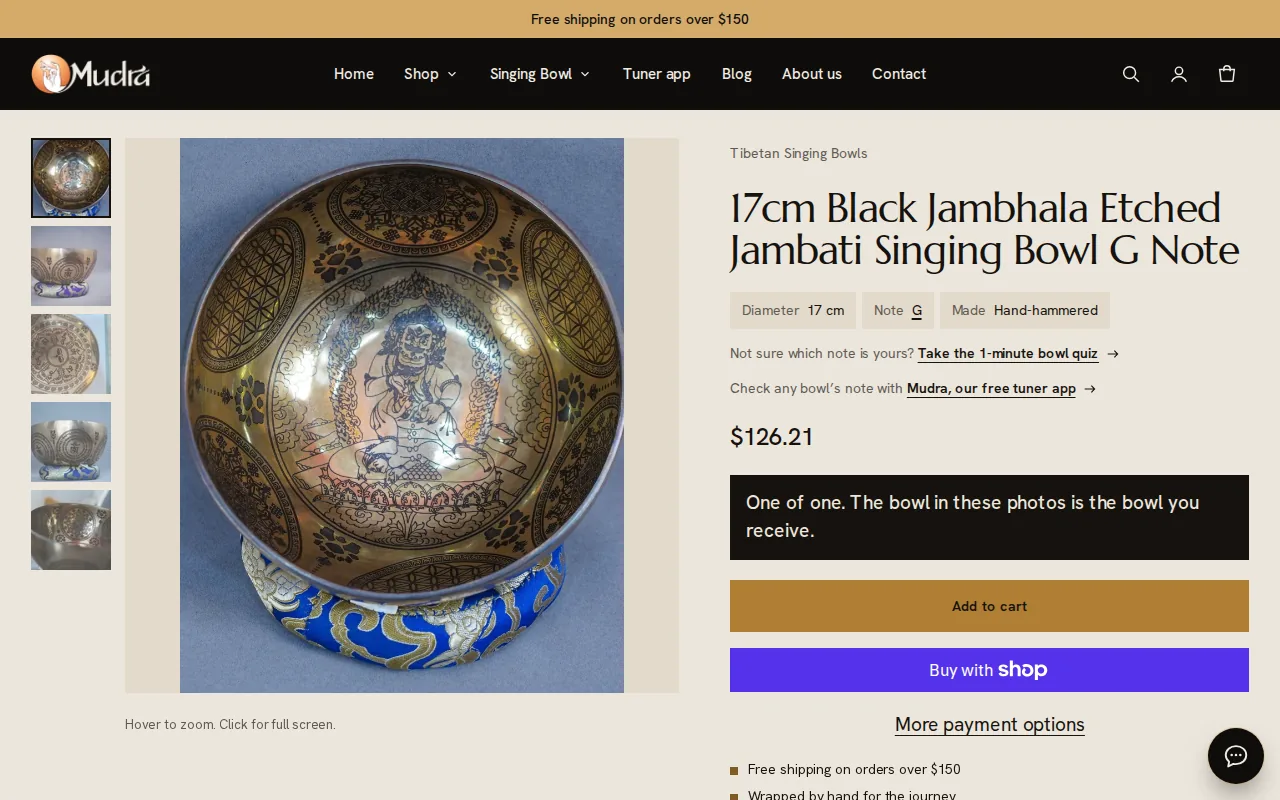
Why it wins: G is the note tradition gives the throat, and many people pair it with chanting. This bowl's voice is clear, with a bright sustain, and at 17 cm it is small enough to hold while you recite.
Runner-up: the 22 cm Lingam Tiger Full Moon has a raised point in the centre of its floor that adds to the layering of its G. More in the note G collection.
Best note A singing bowl: 25 cm Jambati Tiger Full Moon
For A we chose the 25 cm Jambati Tiger Full Moon: a big, open bowl with a dark spotted patina and the round Full Moon symbol carved on its side.
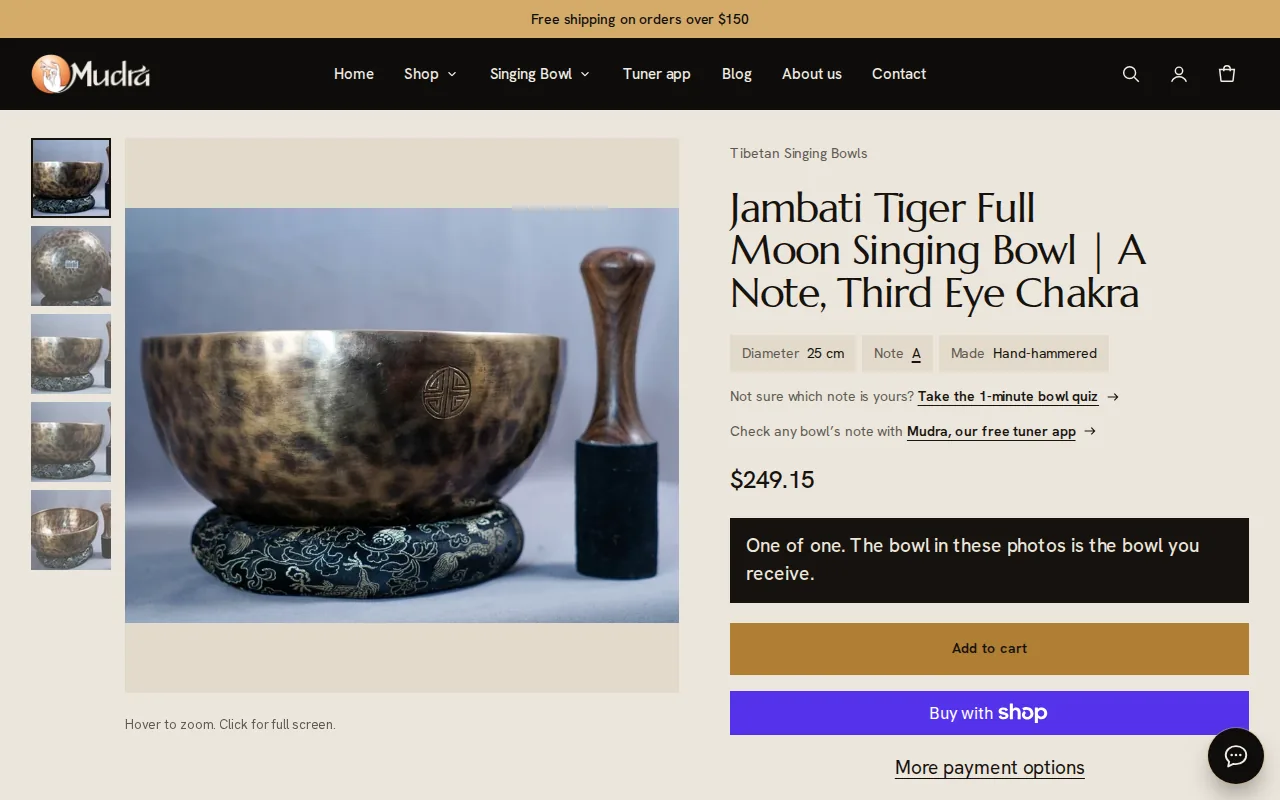
Why it wins: struck with the suede-tipped mallet, the A rings clear with deeper overtones underneath. Circled at the rim it builds into a broad hum that carries across a room, which makes it a strong bowl for group meditation and sound baths.
Runner-up: if you want an A that is also a centrepiece, the 34 cm Shakyamuni Buddha Silver Carved Jambati has a seated Buddha worked in silver at the bottom of the basin.
What about note B?
We have no B bowl in stock at the moment, and we would rather say so than sell you a bowl in a different note. It is the note we have had least often. If you need a B to finish a seven-note set, check our note B collection later, or test any bowl you already own with a tuner first. Sometimes a bowl sold as one note reads as another.
How to choose your note
There is no single right note. These are the questions that usually settle it:
- Are you building a set? Start with the C or D and add notes one at a time. Our guide to building a singing bowl set walks through the order.
- Do you play with other instruments or your voice? Pick the note that matches your key, and check the bowl's real pitch in hertz, not only the note name.
- Do you follow the chakra tradition? Use the chart above to match the note to the chakra you are working with in your practice.
- Is it your first bowl? Choose the note whose sound you like best. A bowl you enjoy playing gets played.
To check the note of a bowl you already own, use Mudra, our free tuner app for iPhone, iPad and Android. Strike or circle the bowl and it names the note and the hertz. The Mudra app page has the download links, or see how to find the note of your singing bowl by ear and by app.
Frequently asked questions
Which singing bowl note is best for beginners?
Any note works, so pick the one you enjoy hearing. If you think you may build a set later, a C or D is a natural first step, since those are the first two notes on the chart.
Can two bowls in the same note sound different?
Yes. The note names only the fundamental. Size, weight, wall thickness and hammering change the overtones, the sustain and the beat you hear as the sound fades, so two D bowls can feel very different.
Do singing bowls play in an exact pitch?
Rarely to the hertz. Handmade bowls are not tuned like a piano, so a bowl listed as D may sit a little sharp or flat. A tuner app shows exactly where yours sits.
Which note matches which chakra?
In the chart we use, C is root, D sacral, E solar plexus, F heart, G throat, A third eye and B crown. This is a tradition many sound practitioners follow, not a scientific measurement.
How many notes do I need for a full set?
A traditional chakra set has seven bowls, one for each note from C to B. Many people start with one or two and add more over time.
Ready to hear your note? Browse our hand-hammered bowls at Mudra Craft, or start with the note collections linked above. Each bowl is one of one, and the bowl in the photos is the bowl you receive.


