

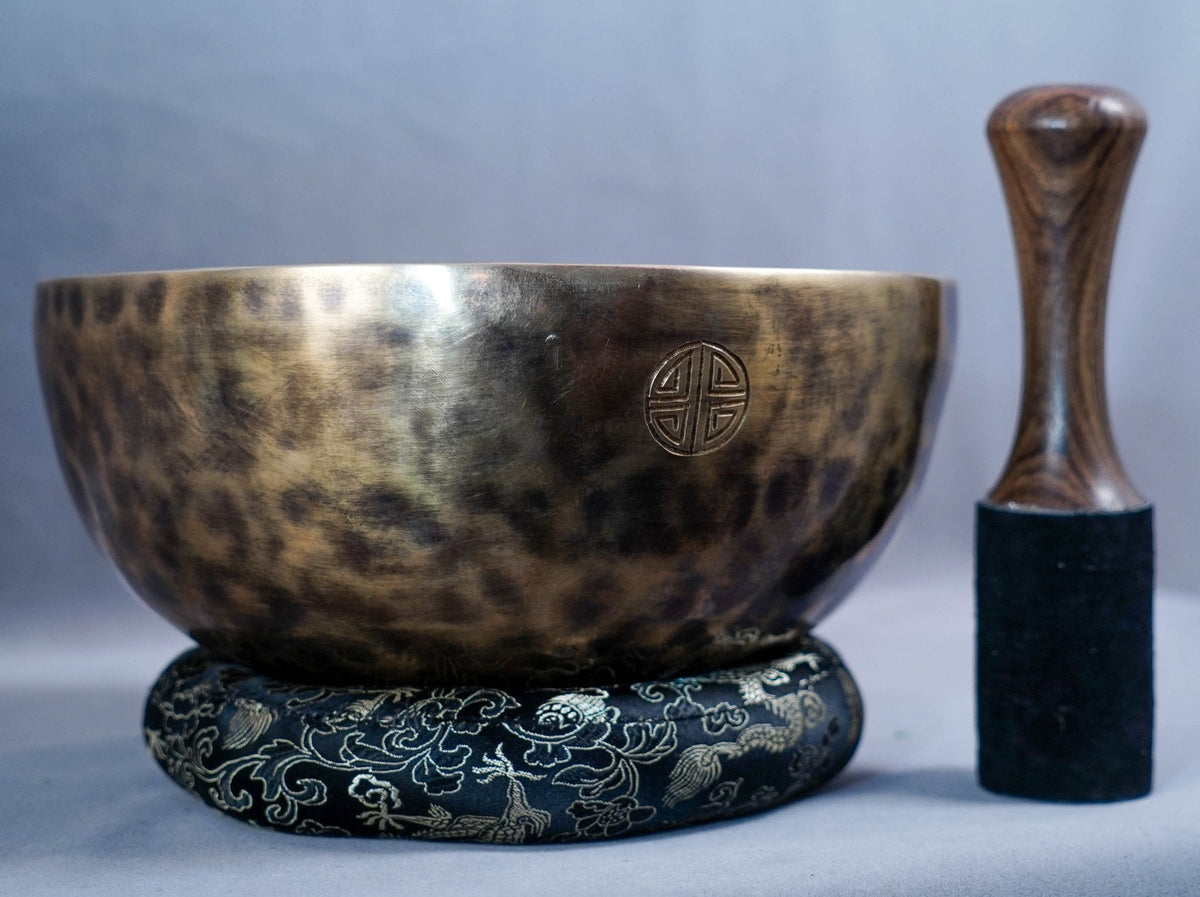
A singing bowl is a bowl-shaped bell that rests on its base instead of hanging. Strike the rim with a mallet, or circle the mallet around the outside of the rim, and the metal rings with a long, layered tone. They are often called Tibetan singing bowls, but many are made in Nepal, and ours are made by artisans in Kathmandu. You can browse all our singing bowls or take the 1-minute bowl quiz to find one that suits you.
This guide covers the whole subject in one place: what a bowl is, how it sounds, the main types, notes and chakras, choosing, care, where bowls are made and where they come from. Each part links to a deeper guide, and if a word is new, our singing bowl glossary explains it.
What is a singing bowl?
A singing bowl is a standing bell: a metal bowl that sounds when you strike or rub its rim. It sits on a cushion or on your open hand, and the walls and rim vibrate freely to make the sound.
Most metal singing bowls are bronze, and some are brass. They come in many sizes, from small bowls that fit on your palm to very large bowls that sit on the floor. Many people use them to relax, to meditate, to mark the start and end of a sitting, or in sound therapy sessions. Others simply enjoy them as handmade instruments.
You will see several names for the same thing:
- Tibetan singing bowl is the most common name. It describes the style and the tradition, not where a bowl was made.
- Himalayan singing bowl is another name for the same metal bowls.
- Crystal singing bowls are a modern relative made from quartz. This guide is about metal bowls; our guide to crystal vs metal singing bowls compares the two.
How does a singing bowl make its sound?
When you strike a singing bowl, its walls flex in and out and the rim vibrates. That vibration moves the air, and you hear a lowest tone, called the fundamental, with several higher tones ringing above it, called overtones or partials.
A bowl's overtones are not neatly spaced like the overtones of a guitar string, which is part of why a bowl sounds like a bell. Hand-hammered bowls are a little uneven, so many have a "split note": two very close tones that beat against each other in a slow wah-wah pulse, called the warble. It is a normal feature of a handmade bowl, not a fault.
Rubbing the rim works differently. The mallet grips and slips against the metal over and over, which keeps the vibration going, so the tone builds into a steady hum. That is the "singing" in the name.
To play, rest the bowl on its cushion or on your open palm. Strike the outside of the rim gently with the mallet and let it ring, or press the mallet against the outside of the rim and circle it slowly until the bowl starts to sing.
Our guide to how singing bowls make sound explains the physics in plain words, and the singing bowl frequency chart covers hertz, cents and overtones. To see those tones for yourself, how to read a singing bowl spectrum explains the fundamental, partials and warble on screen.
What are the main types of singing bowls?
Singing bowls are named in three ways: by shape (Jambati, Thadobati, Ultabati, Lingam, Naga), by finish or style (Tiger, Full Moon) and by how they are made (hand-hammered, or cast and lathe-turned). One bowl can carry more than one name. Our Lingam Tiger Full Moon bowl, for example, is a Lingam, a Tiger and a Full Moon bowl at once.
Here are the types you will meet most often. Our guide to the types of singing bowls covers more shapes and finishes.
Jambati singing bowls
The Jambati is the classic hand-hammered shape: a wide, rounded body on a flat base, with the wall curving gently inward at the rim. Jambati bowls are made in many sizes, from small bowls that sit on your palm to large ones that rest on the floor, and the large ones have a deep, long-lasting voice. Browse our Jambati singing bowls, such as the Dim Plain Jambati in note D.
Thadobati singing bowls
A Thadobati has straight, almost upright walls and a flat base, so it looks more like a deep cup than a dish. The straight wall is the easiest way to tell it apart from a Jambati, whose wall curves inward at the top.
Ultabati singing bowls
An Ultabati has thick walls and a rounded body, the shape of a monk's alms bowl, and makers describe its rim in different ways. Our Bodhgaya Monk Bowl is a small Ultabati in note D whose rim flares outward. See the Ultabati collection.
Tiger singing bowls
Tiger is a finish, not a shape. The metal keeps a dark, mottled, striped patina from the fire and the hammering, a little like a tiger's coat, so a Tiger bowl can also be a Jambati, a Lingam or a Full Moon bowl. Browse Tiger singing bowls, from the small Tiger Jambati in note D upward.
Full Moon singing bowls
Full Moon bowls take their name from the custom of forging them on full-moon nights. It is a tradition, not something you can check on any one bowl. Many carry a round symbol on the side. See our Full Moon singing bowls, including the large Jambati Tiger Full Moon bowl in note A.
Lingam singing bowls
A Lingam bowl has a raised point rising from the centre of its floor. The name refers to the lingam, a symbol of Shiva in Hindu tradition. Our Lingam Tiger Full Moon bowl is in note G. See all Lingam singing bowls.
Naga singing bowls
A Naga bowl stands on a raised foot instead of sitting flat on its base, which gives it an upright, almost chalice-like look. The Naga Plain Antique bowl is in note C. See the Naga collection.
Cast and lathe-turned singing bowls
These bowls are made by pouring molten metal into a mould, then turning the bowl on a lathe to smooth and finish it. They have even walls, fine turned rings and often etched designs such as Om or a mantra; singing bowl symbols explains what these and other etchings mean. Some of ours are brass, like the Black Gold Om bowl. See cast and lathe-turned singing bowls.
Very large floor bowls
The biggest bowls are made to rest on the floor rather than in the hand. Our feet therapy collection holds bowls of this size, such as the 44 cm Feet Etched Grounding bowl in note C.
What are singing bowls made of, and how are they made?
Most singing bowls are bronze, an alloy of copper and tin, and some are brass. They are made in one of two ways: hammered by hand from a hot disc of metal, or cast in a mould and turned on a lathe.
Hand-hammered or cast: what is the difference?
| Hand-hammered | Cast and lathe-turned | |
|---|---|---|
| How it is made | A disc of metal is heated and hammered into shape again and again, often by a team of smiths | Molten metal is poured into a mould, then the bowl is turned smooth on a lathe |
| How it looks | Hammer marks and small unevenness; no two are alike | Smooth, even walls and fine turned rings |
| How it tends to sound | Layered, with strong overtones and often a warble | Simpler and steadier |
| Usual metal | Bronze | Brass or bronze |
Neither is better for everyone. They sound different, so choose by ear. We sell both, and our guide to hand-hammered vs cast singing bowls explains how to tell them apart.
What does "7 metal" mean?
"7 metal" is the traditional name for the bronze that many Nepali singing bowls are made from. The tradition names seven metals, each linked with a heavenly body: gold with the Sun, silver with the Moon, mercury with Mercury, copper with Venus, iron with Mars, tin with Jupiter and lead with Saturn.
The base of the alloy is copper and tin, which is what makes bronze ring. Our guide to 7 metal singing bowls goes into the metal and the tradition behind the name. Bowls whose listings say 7 metal are together in our 7 metal singing bowls collection.
What note is my singing bowl, and how can I find it?
A bowl's note is the letter name of its fundamental, the lowest strong tone it makes: C, D, E, F, G, A or B. The note is set when the bowl is made, and you cannot retune a metal bowl yourself.
In general, bigger and heavier bowls sound lower, but shape matters too, so there is no fixed size-to-note rule. A handmade bowl also rarely sits exactly on a note. The gap is measured in cents, one hundredth of a semitone, so a bowl can be a few cents sharp or flat of its note. That is normal and describes the sound you own.
The easiest way to find the note is with a tuner built for bowls. Open the free Mudra - Singing Bowl Tuner app on your iPhone, iPad or Android phone, go to Detect, strike the bowl once and read the note. Mudra shows:
- the note, its frequency in hertz and how many cents the bowl sits above or below it
- the chakra that note is traditionally linked with
- in Pro mode, a live spectrum, a table of partials, the loudest overtone and the warble
Ordinary tuner apps often jump between notes on a singing bowl, because some overtones can be louder than the fundamental. Mudra was built to hear through them to the bowl's real fundamental. We tested it only with real sound played to real phones: on 73 real hand-forged Jambati singing bowls, from about 100 Hz to about 690 Hz, it showed each bowl's labelled note on all 73 in the final test, with the first reading about 1 to 1.5 seconds after the strike. Our article on how we tested the Mudra tuner explains the method.
Mudra is free, for iPhone, iPad and Android, with no ads, no account and no tracking. Listening happens on your device, and the sound is never recorded or uploaded. The whole Mudra Craft store is inside it too: you can browse our bowls in your own currency, see each bowl's note, save bowls to a cart and check out on mudracraft.com. See the free Mudra singing bowl tuner app page for more.
For step-by-step help, read how to find the note of your singing bowl. To compare tuners, see what makes a good singing bowl tuner.
Which chakra goes with each note?
In the tradition we follow, each of the seven notes is paired with one of the seven chakras. Many people use the chart to choose a bowl, or to build a set with one bowl per chakra. It is a tradition, not medicine, and other charts exist, some with different notes.
| Note | Chakra (traditional pairing) | Shop |
|---|---|---|
| C | Root | C note bowls |
| D | Sacral | D note bowls |
| E | Solar plexus | E note bowls |
| F | Heart | F note bowls |
| G | Throat | G note bowls |
| A | Third eye | A note bowls |
| B | Crown | Ask us |
Our singing bowl chakra guide explains the pairing and why charts differ. To shop this way, see bowls by chakra. To grow a set one bowl at a time, see how to build a singing bowl set.
How do I choose a singing bowl?
Choose in this order: note, type, size, then budget. The note is the bowl's voice, so it matters most; type and size shape how it sounds and how easy it is to play.
- Note. Pick the voice you like, higher and bright or lower and deep. If you work with chakras, let the chakra choose the note.
- Type. Hand-hammered for a layered sound, or cast and lathe-turned for a simpler one. Shape and finish are a matter of taste.
- Size. Small bowls sound higher and are easy to hold, which suits a first bowl or travel. Large bowls sound lower, ring longer and sit on a cushion on a table or the floor.
- Budget. Prices vary with size and type, and each listing shows its price.
Most of our listings name the bowl's note, so you know what you are buying. When it arrives, you can check it with Mudra, and how to test a singing bowl lists the other checks worth making. Our guide on how to choose a singing bowl goes into each step, and the 1-minute quiz gives you a short list.
How do I clean and care for a singing bowl?
Keep it dry, handle it gently and wipe it with a soft, dry cloth. A singing bowl needs very little care, and most harm comes from damp, harsh cleaners and drops.
- Wipe after playing. Fingerprints can mark polished metal, so a quick wipe with a soft cloth keeps it clean.
- Keep it dry. If you play with water in the bowl, empty it and dry it afterwards. Never put a bowl in the dishwasher.
- Go easy on polish. Tiger, black and antique-style finishes are part of the bowl. Abrasives and metal polish can strip them.
- Store it safely. Keep it on its cushion, somewhere it cannot fall. A drop can dent or crack a bowl and change its sound.
Our guide on how to clean a singing bowl covers each finish and what to avoid.
Where are singing bowls made?
Many of the singing bowls sold around the world are made in Nepal, in and around the Kathmandu Valley. "Tibetan singing bowl" is the common name, but our bowls are made by artisans in Kathmandu, not in Tibet.
The Newar people of the Kathmandu Valley have a long tradition of metal craft, and the old city of Patan is known for it. Today, hand-hammered bowls are usually shaped by small teams of smiths who heat and hammer the metal in turn, while cast bowls are made in workshops with moulds and lathes.
Read more in singing bowls made in Nepal, meet the makers in the master craftsmen behind singing bowls, and see about Mudra Craft for who we are.
Where do singing bowls come from? History and traditions
Nobody knows exactly when or where singing bowls began. There is no early written record that describes them as instruments, so many origin stories you read are guesses.
What is clear is that metal bowls and bells have been made in the Himalayan region for a long time, and that several traditions are linked with them:
- History. Our history of singing bowls separates what is known from what is legend.
- Buddhist monasteries. Bells, cymbals and offering bowls are well documented in Tibetan Buddhist ritual. The role of singing bowls is less clear, as our guide to singing bowls in Buddhist monasteries explains.
- Bon. Bon is Tibet's pre-Buddhist religion, which also uses bells and other ritual instruments. Read about the Bon tradition and singing bowls, and why the link is hard to prove.
- The West. Singing bowls became widely known in Europe and North America from about the 1970s, through travellers to Kathmandu, recordings, and later sound therapy and sound baths. See how singing bowls came West.
Is a singing bowl a good gift?
Yes, for anyone who meditates, practises yoga, enjoys music or loves handmade things. A bowl is easy to play from the first strike, and each one sounds a little different.
- Pick a size they can hold. A small or medium bowl is easy to play on the palm or a cushion, like the 15 cm Black Full Moon Jambati in note C.
- Choose a note. Go by the sound you think they will like, or by a chakra if they follow the tradition.
- Check what is included. Most of our bowls come with a mallet, and many with a cushion. Each listing says what is in the box.
- Mention the app. With Mudra, free on iPhone, iPad and Android, they can find their bowl's note in seconds.
Our singing bowl gift guide has more ideas, our singing bowl gifts collection gathers the smaller bowls, and you can contact us if you need help choosing.
Questions people ask
Are Tibetan singing bowls made in Tibet?
"Tibetan singing bowl" is the common name for the style. Many are made in Nepal, and ours are made by artisans in Kathmandu.
What is the best singing bowl for a beginner?
One in a note you like, in a size you can hold comfortably. The 1-minute quiz can point you to one.
Do I need anything else to play a singing bowl?
A mallet, and ideally a cushion so the bowl rings freely. Most of our bowls come with a mallet; each listing says what is included.
How can I find out my bowl's note for free?
Use the free Mudra app for iPhone, iPad and Android. Strike the bowl once and it shows the note, hertz and cents.
Are singing bowls a medical treatment?
No. Many people use them to relax and meditate, but sound practice is not a medical treatment.
What do words like Jambati, partial and warble mean?
Our singing bowl glossary explains them, along with dozens of other terms.


